Let me check. My feeling is, that pkcs11-tool will routinely prompt for the PIN if CKF_PIN_REQUIRED is indicated. I assume engine-pkcs11 does the same.
- Company
- News
- Products
- Solutions
- Support
- Shop
Let me check. My feeling is, that pkcs11-tool will routinely prompt for the PIN if CKF_PIN_REQUIRED is indicated. I assume engine-pkcs11 does the same.
Hello @sc-hsm ,
If your feeling is good, then the conclusion is that what we want to achieve is not possible currently.
Just to be clear on the context:
One option (our side) should be to “modify/patch” the softwares used to sign:
But we don’t like/want this option:
Another option will be (in your side), but I don’t know if this is possible or even “wanted” (for security reasons):
Option A: (most secure, but more difficult to implement)
Option B: (less secure, but faster to implement)
With these two solutions, the n-of-m authentification will not be directly integrated in the “standard” tools (OpenSSL, pkcs11-tools, etc), BUT it will be usable with! We just need to add a step before calling these tools to “unlock the HSM”
What I have in mind is a little different:
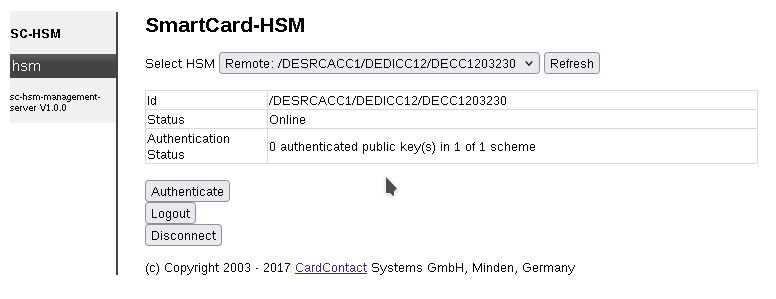
We have PKA in the portal, which implements the required authentication steps with a device that is remotely connected. We could integrate this connectivity behind the C_Login call in the PKCS#11 module, so that whenever an application calls C_Login, the token is connected to the portal, where you could perform PKA. If PKA is complete, the connection is closed and C_Login completes, allowing the application to continue.
That would allow arbitrary applications to use PKCS#11 without adding user-facing support for PKA.
There is the sc-hsm-management-server repo in the CDN that implements just the PKA part in a simple web service, if running the full portal instance is too much.